What Is Uranian Astrology?
Why It Fascinates Me and Why You Should Know More About It
Have you ever wondered whether your birth chart contains more information than conventional astrology can reveal?
Uranian Astrology is an advanced system of Western Astrology developed by Alfred Witte in Germany in the early twentieth century. Unlike conventional astrology, which primarily focuses on planetary placements, zodiac signs, houses, and major aspects, Uranian Astrology offers a more detailed approach to understanding the connections between planets and the events they may represent.
The system introduces eight hypothetical Transneptunian planets, including Cupido, Hades, Zeus, and Kronos. These are mathematically calculated points that have their own symbolic meanings within Uranian Astrology. They are used alongside traditional planets, midpoints, planetary equations, and other astrological factors.
How Does Uranian Astrology Work?
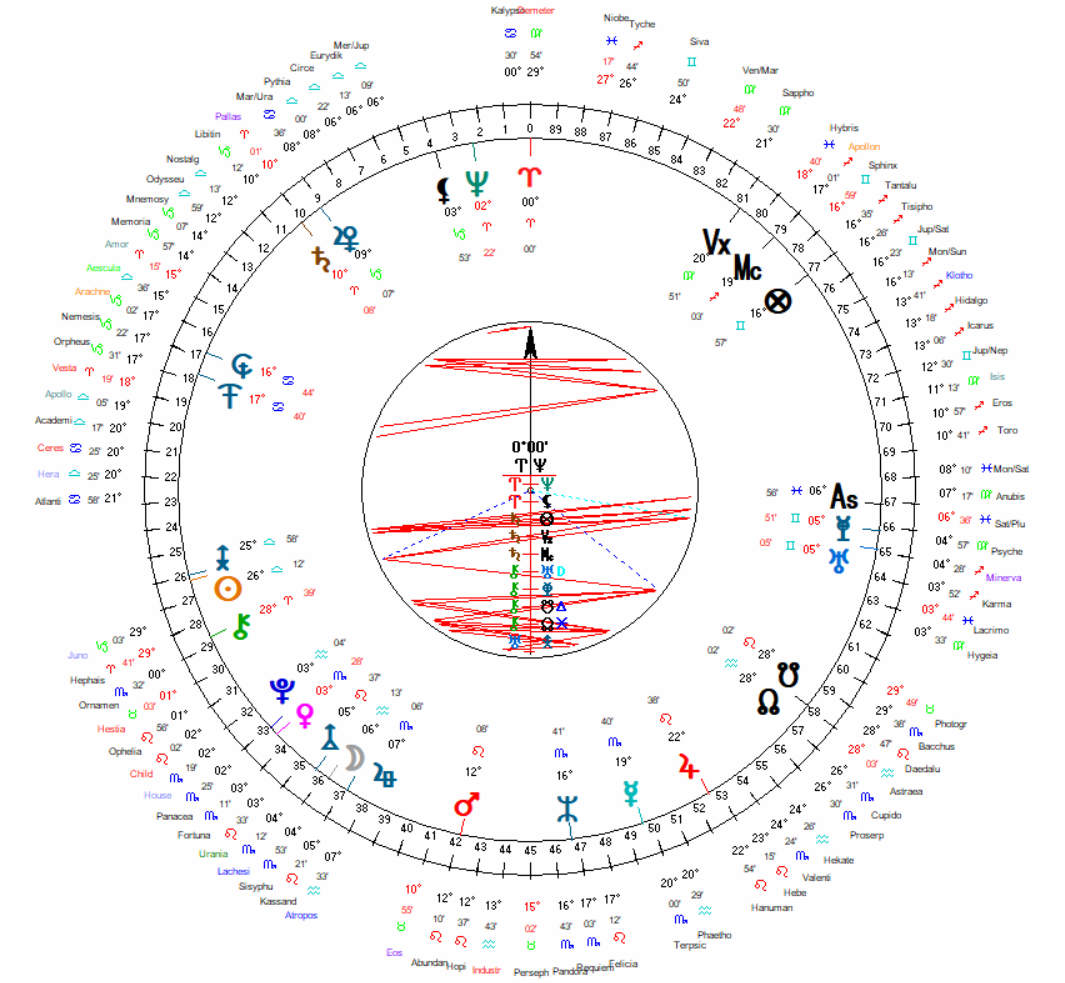
One of the most distinctive features of Uranian Astrology is its 90° dial system.
Instead of examining the birth chart only as a 360° circle divided into twelve houses, Uranian Astrology rearranges planetary positions within a 90° dial. Imagine folding your birth chart into four equal sections and then examining its planetary connections with a magnifying glass.
This method makes it easier to identify certain aspect patterns that may not immediately attract attention in a conventional birth chart.
Uranian Astrology primarily emphasizes conjunctions (0°), squares (90°), oppositions (180°), semisquares (45°), and sesquiquadrates (135°). These aspects are particularly important because they are traditionally associated with tension, movement, and activation.
However, tension does not necessarily mean something negative. It can also represent the circumstances that push us to make decisions, pursue opportunities, overcome difficulties, and experience significant changes.
While conventional astrology can help us understand who we are, Uranian Astrology places particular emphasis on what happens in our lives and how different planetary energies become activated.
What Makes Uranian Astrology Different?
Let's consider a simple example. Imagine that you have the following placements in your birth chart:
Sun at 5° Aries
Venus at 20° Taurus
Moon at 5° Cancer
Mars at 20° Leo
In conventional astrology, some of these planets form familiar major aspects, while other connections may receive less attention.
However, when we examine these placements on the 90° dial, we discover a more detailed pattern. The Sun and Moon occupy the same position on the dial, while Venus and Mars appear on the opposite side. Together, they form a network of 45°, 90°, and 135° aspects.
This allows us to examine how these four planets may operate together rather than interpreting each placement separately.
Now, imagine introducing additional asteroids, Transneptunian planets, and midpoints into this configuration.
This is where Uranian Astrology becomes particularly interesting.
What Can Uranian Astrology Reveal?
In my practice, I combine the Uranian system with more than 70 asteroids to examine the details of planetary configurations.
Each component contributes a different layer to the interpretation.
Transneptunian planets help establish the underlying themes of a planetary configuration. Their contacts can provide additional context for understanding the nature of an experience.
Asteroids introduce more specific themes and symbolic associations. I use them to explore the people, circumstances, experiences, and actions associated with particular configurations.
Midpoints reveal how two planetary energies interact and how their combined symbolism may be expressed through another planet. For example, an equation such as Sun/Venus = Jupiter brings together the meanings of all three planets.
Planetary equations and calculations provide further information about the relationships between different points in the chart. These include combinations such as Sun + Sun, Saturn + Jupiter, and Saturn − Moon, each of which has its own interpretation within the system.
Together, these techniques allow me to examine the birth chart from several different perspectives.
Can Uranian Astrology Predict Events?
One of the reasons I particularly value Uranian Astrology is its application in predictive work.
Rather than focusing exclusively on personality traits or general tendencies, Uranian Astrology examines the activation of planetary configurations during particular periods of life.
I use this system to investigate significant life developments, age-related periods, planetary transits, solar arc directions, and eclipse activations.
It is also a valuable technique in my practice for birth chart rectification, particularly when examining the correspondence between important past events and specific planetary configurations.
Although no astrological system can guarantee that a particular event will occur, Uranian Astrology offers an additional framework for exploring timing and possible developments.
Is Uranian Astrology Right for You?
If you are already familiar with your birth chart and want to explore it in greater detail, a Uranian Astrology Reading may offer you a new perspective.
Perhaps you have already had a conventional birth chart reading but feel that certain experiences, recurring patterns, or significant events deserve further examination.
Uranian Astrology allows us to investigate these questions through a different analytical system.
However, if you are completely new to astrology and have never had your birth chart interpreted before, I recommend beginning with a regular Natal Chart Reading. Understanding the fundamental features of your birth chart provides an important foundation before exploring the more technical details of Uranian Astrology.
Your birth chart contains many layers of symbolism. Uranian Astrology offers another way to examine them.
If you are ready to explore those layers, you are more than welcome to book a Uranian Astrology Reading with me.